1) define the word catalyst: a substance that changes the rate of reaction
2) why is catalyst used? to speed up the reaction rate of cracking, they can also slow down reactions such as for rusting
3) why are high temperatures needed?high temps are needed to break the strong covalent bonds in the hydrocarbon
What types of catalysts are used for cracking? silica and alumina
What equipment do you need to collect the gas? boiling tube, a basin full of water, delivery tube.
What hydrocarbon is he cracking? paraffin
How are alkanes tuned into alkenes? through cracking with either silica or alumina as the catalyst
At what temperature can this experiment work at? 600-700 degrees celsius
Tuesday, May 17, 2011

5.12 I can recall the problems associated with fractional distillation of crude oil
Read chemistry for you page 145
a) when crude oil undergoes fractional distillation there are too many long chain hydrocarbons (eg bitumen ) produced and not enough shorter chain hydrocarbons (eg refinery gases)
b) to solve these problems the large chain hydrocarbons undergo a chemical reaction called cracking.
a) when crude oil undergoes fractional distillation there are too many long chain hydrocarbons (eg bitumen ) produced and not enough shorter chain hydrocarbons (eg refinery gases)
b) to solve these problems the large chain hydrocarbons undergo a chemical reaction called cracking.
5.11 I can recall how nitrogen oxides are formed in car engines
a. Write the general equation for the combustion of a fuel : fuel + oxygen -----> energy + oxides
b. During combustion the nitrogen in air can react to form what gases? NOx gases
c. What condition is necessary for the formation of these gases? high temperature
d. In what common object is this condition found? in cars
e. Why is this condition needed for nitrogen to react? they nitrogen molecules are diatomic and have triple covalent bonds
f. What are the dangers of the products from this reaction? asthma, cancers, acid rain
Monday, May 16, 2011
Tuesday, May 10, 2011
5.10 recall that incomplete combustion of fuels may produce carbon monoxide and explain that carbon monoxide is poisonous because it reduces the capacity of the blood to carry oxygen
What are the properties of carbon monoxide? Clear, odorless gas, cant see it, highly poisonous
Explain how carbon monoxide is formed? Through incomplete combustion when there is insufficient oxygen
Explain why carbon monoxide is poisonous? it binds very strongly to hemoglobin, when it attaches, it is very difficult to release, when you breath in carbon monoxide, it sticks to your hemoglobin and takes up the oxygen binding sites. and your blood loses ability to transport oxygen, and you suffocate.
5.9 describe the trend in boiling point and viscosity of the main fractions
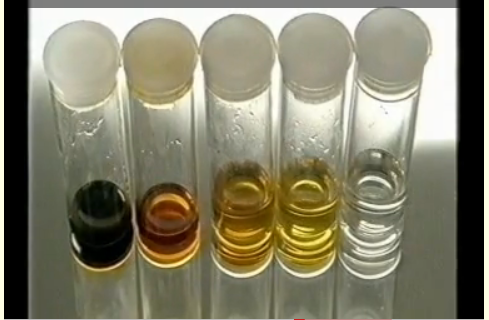
a. What is the trend in boiling point of the fractions? as you go lower the fractions the boiling point gets higher
b. Define viscosity the thickness of a liquid
c. What is the trend in viscosity of the fractions? higher viscosity towards the bottom of the fractionating column
What is the trend in colour of the fractions? colour gets darker when fractions have a higher viscosity
What is the trend in colour of the fractions? colour gets darker when fractions have a higher viscosity
e. Why is crude oil separated into fractions? Crude oil on its own its useless, when extracted it has lots of uses
f. What process is used to separate crude oil into fractions? Fractional distillation
g. What physical property allows this process to work? each fraction has adifferent boiling point


Subscribe to:
Posts (Atom)